
Understanding Shelfmarks
In Biography, books are filed alphabetically by the name of the book’s subject. If two subjects have the same surname, the first name is taken into account. Books about a family will precede books about the individual. For example, a shelf order may run Smith, family of, followed by Smith, Anna, then Smith, Emily etc. Please note that names are treated as one word regardless of gaps, hyphens or apostrophes. Names that start Mc are treated as though the spelling is Mac.
Above is an example of a book record from the Catalogue. Here you can see that the book is shelved under the author’s name and that it is available (i.e. on the shelf) in the Biography section (Biog.), and then in the Christie sub-section. Within the section of each author, titles are shelved in the following order:
- Autobiographies and Memoirs
- Correspondence and Letters
- Diaries and Journals
- Speeches
- Books written about the subject
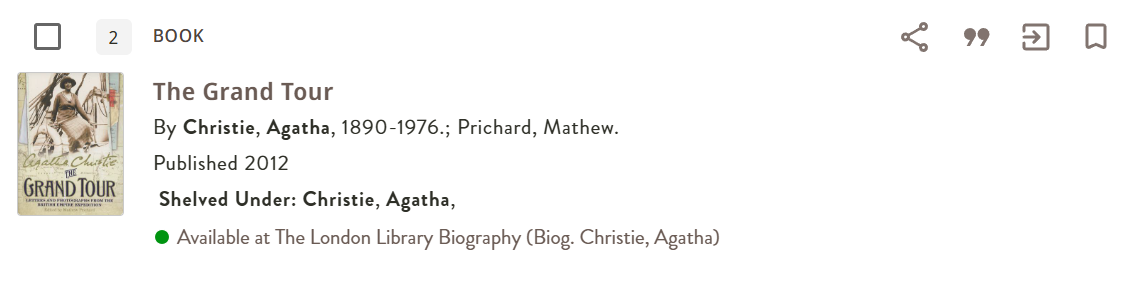
In the second example, the book will be in the Christie sub-section, but shelved under the author’s name (Prichard) within that section. Please note that in order to make the most effective use of space, the collection is also shelved by size. Check the end of shelf marks for the notations 4to (quarto), folio and folio extra large that may indicate a different place to look for the books. In general, larger volumes are shelved in the same room as the smaller.
Books may be requested and put aside for ready for collection, but we would always encourage members to browse the shelves for themselves and discover the books they did not know they needed. Rare texts and anything published before 1700 may have been moved to our Special Collections. Items that cannot be borrowed, can be consulted in the Library under supervised conditions with 72 hours’ notice. Please speak to staff in the Issue Hall if you have any questions.