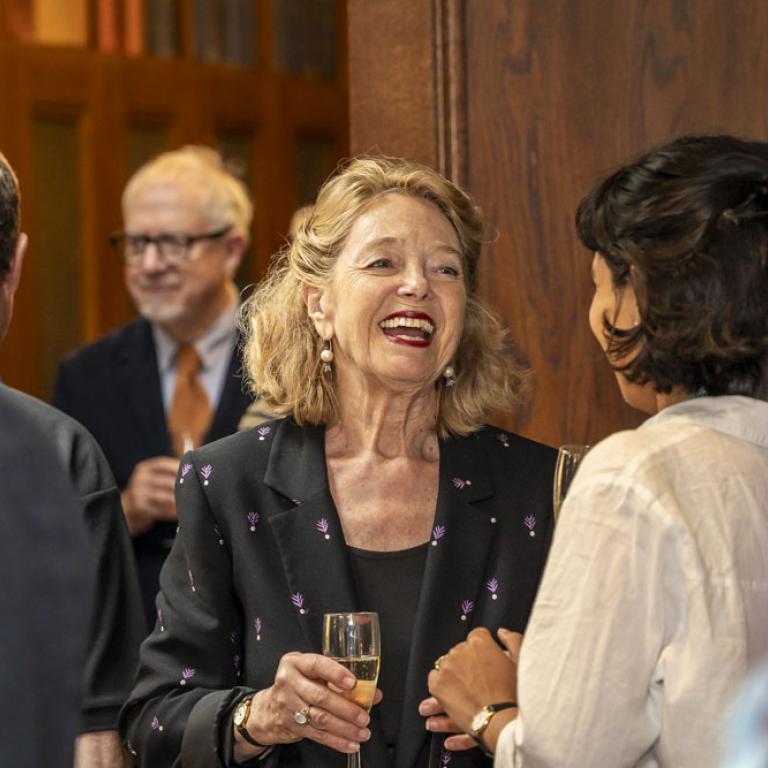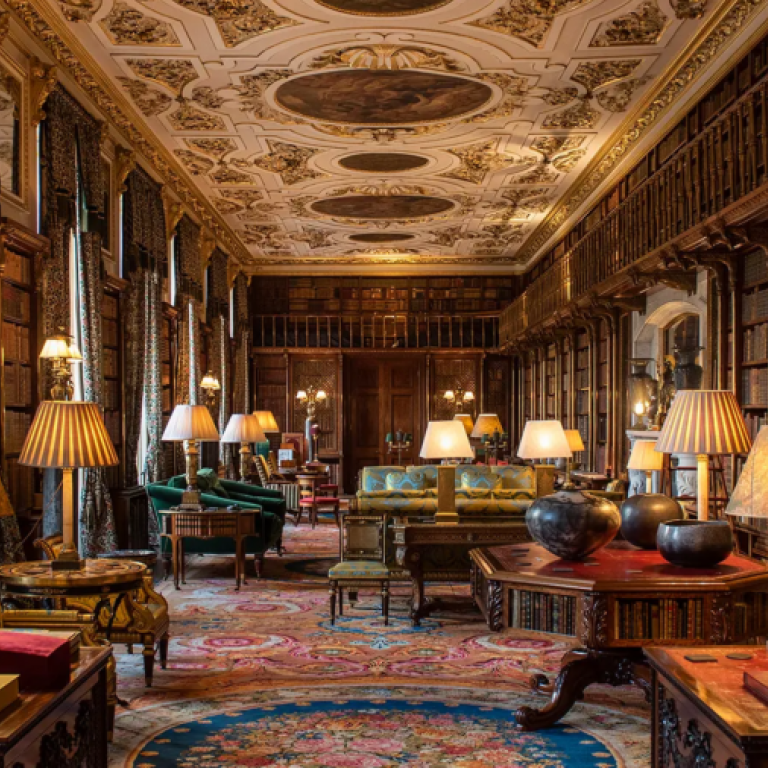
two women shaking hands at event in new room at london library

Patronage

Patrons enjoy opportunities to engage more deeply with the Library through exclusive events, behind-the-scenes access and conversations with writers, curators and fellow supporters.  

Patronage can also be gifted, offering a meaningful way to support a unique literary institution while sharing the experience with others.

Please note that Patronage does not include Library membership.
Patron levels

Patron levels
Benefits
Annual amount
Donation/benefit split

Martineau 

  • Deepen your knowledge of literature, history and the arts through our regular talks programme

  • Gain out-of-hours access to our unique collection and the libraries of other cultural and historic institutions

  • Connect with fellow Patrons at our annual Supporters’ Lunch

  • Join us with a guest at our Summer and Christmas parties

  • Have your name acknowledged on our donor boards in the Library and in our Annual Report

£1,800 

Donation: £1,500

Benefit: £300 

Thackeray 

All Martineau benefits, plus:

  • Exclusive visits to private book collections in London and beyond

  • An invitation for you and a guest to the annual Chair’s Dinner, joined in conversation each year by a notable Library member

£6,000

Donation: £5,380

Benefit: £620 

Dickens 

All Martineau and Thackeray benefits, plus:

  • A private annual lunch with the Chair or Director of the Library

  • A bespoke tour for you and up to five guests, featuring treasures from the Library’s collection 

£12,000

Donation: £11,240

Benefit: £760 

Become a Patron

We are grateful to the following patrons who each made a contribution to the Library’s work in 2025/26.

Current Patrons

UK Patrons

Dickens Patrons

John Colenutt, Howard Davies, Simon Godwin, Simon King, Basil Postan, Sir Timothy Rice, Kimberley Samuel, Mark Storey, Jane Waller, Philip Winston (with matching gift from Capital Group), Georgia Winter

Thackeray Patrons

Alain Aubry, John Clappier, Michael Cohen & Erin Bell, Eric Coutts, Reverend Paul Gismondi, Andrew Hine, Anne Lambirth, Peter T G Phillips, Frances Prenn

Martineau Patrons

Mohammad Almojel, James Bartos, The Bisset Trust, Sue Bradbury OBE, Philip Broadley, Stephen Peter Brook, Consuelo & Anthony Brooke, Anthony Cardew, Peter Herbert Chapman, Nicola Coldstream, Lady Ros Cox & Sir Alan Cox, Jeremy Curtis, Johnnie Gallop, Sir John Gieve, David Gillott, Jakob Haesler, Harriet & Fabian Hielte, Marianne Hinton, Philip Hooker, Dr Sarah Ingham, David Ireland, Humphrey Lloyd, David Lubin, Jennifer Jordan McCall, Dame Heather McGregor, Kamalakshi Mehta, Patrick Parrinder, David Reade, Peter Rosenthal, Deepak Sarup, Jeremy Sillem, Edward Simmons, Peter Stewart, Marjorie Stimmel, Paul Swain, Emanuela Tandello-Cooper, Luanne & Hodson Thornber, Jenny Tozer, John C Walton, Paula Weideger, Steven & Amanda Whitaker, Stephen Withnell, Alice Jolly on behalf of the Laura Kinsella Foundation

US Patrons

Dickens Patrons

Wilson Braun & Mary Connolly Braun, John & Kiendl Gordon, Shannon Hunt-Scott & Kevin Scott

Thackeray Patrons

Peter & Millicent Bain, David & Molly Lowell Borthwick, Eden Collinsworth, Lucie Jay, Mrs Robert Ian MacDonald, Deborah Goodrich Royce, Susan Jaffe Tane

Martineau Patrons

Elizabeth Belfer, Mrs Montague H Hackett, Jr, Carey Adina Karmel, Thomas W Keesee III, Michael T & Helen B Kiesel, Patricia & Tom Lovejoy, Charles Miers/Rizzoli New York, Susan R Palm, Sarah & Hank Slack, Sarah & David Stack, Gillian & Robert Steel, Susan Tinsley, Cissy & Curt Viebranz, John Wilson

Support received via The International Friends of The London Library, a US registered 501(c) (3) charitable corporation.

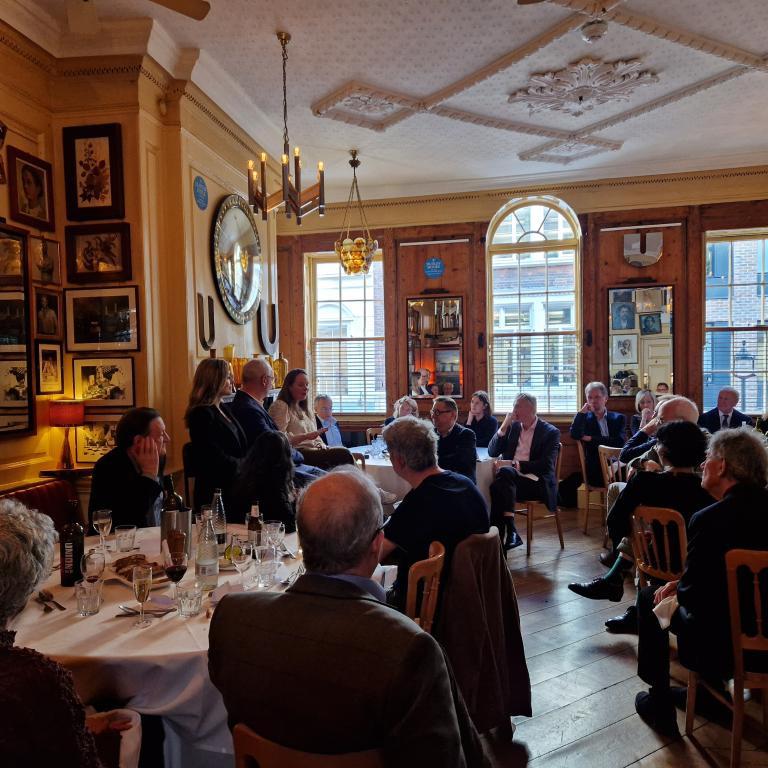
People sat around tables at a supporters lunch

Patron & Library Membership

Join the Patron Circle at your chosen Patronage level combined with Library membership and enjoy all the benefits of being a member. Browse, borrow and discover one million volumes on our open shelves, access thousands of eResources from wherever you are, and quiet desks in the heart of London. 

Speak to the Development team for more information. 

Founding members

The Library’s Patron levels are named after Harriet Martineau, William Makepeace Thackeray and Charles Dickens, three of the 382 founding members of the Library. Thackeray also served as the Library’s first auditor, and Dickens was a member of the Committee running the Library between 1846-47. All three provided the Library with the crucial funds needed to purchase its first 2,000 books, beginning what has since grown into our outstanding, one-million-strong collection.

Harriet Martineau

(1802–1876)


Was an English novelist and social theorist in the field of comparative sociology. Her innovative use of popular fiction to address political and economic issues helped to establish the fictional medium as a vehicle of social reform. Her 1838 work How to Observe Morals and Manners was a pioneering early systematic methodological treatise, in a discipline that philosopher and writer Auguste Comte would term ‘sociology’ the following year.

In addition to 50 books, Martineau penned over 1,600 articles on enslavement, and her three-volume novel The Hour and the Man (1841), about the Haitian general and revolutionary leader Toussaint L'Ouverture, was written to support the abolition of enslavement. This, combined with her vociferous advocacy for women’s education, marked her as a political radical in the eyes of the public on both sides of the Atlantic, but also cemented her legacy as a trailblazing polymath of the Regency and Victorian eras.

William Makepeace Thackeray

(1811–1863)

Was an English novelist and illustrator. Thackeray is particularly known for his 1847–1848 self-illustrated novel Vanity Fair, which satirises British society during and after the Napoleonic Wars, and the 1844 picaresque novel The Luck of Barry Lyndon, which was adapted into the 1975 film Barry Lyndon by Stanley Kubrick.

Thackeray bean his career with satirical sketches such as The Yellowplush Papers (1837), challenging established societal and literary perspectives – and perceived hypocrisy – on high society, military prowess, and the institution of marriage. His ironic cult status among the very echelons of society that his works had lampooned propelled Thackeray to the heights of Victorian celebrity – and perhaps provided motivation for his more mellow, less overtly critical output in his later years – but also firmly secured his place in the British literary canon.

Charles Dickens

(1812–1870)

Was an English writer of novels and short stories, a journalist, and a campaigner for children’s rights and education. Considered by many to be the greatest novelist of the Victorian era, his works and his well-known fictional characters were exceedingly popular during his lifetime and beyond, with critics lauding his astute observation of society and the human character, as well as the satirical and humorous tone of much of his oeuvre.

When he answered Scottish essayist, historian and philosopher Thomas Carlyle’s call to help fund a London-based lending library in 1840, Dickens had written five bestsellers in book and serial form in the space of just four years: Sketches by Boz (1836), The Pickwick Papers (1836-37), Oliver Twist (1837-39), Nicholas Nickleby (1838-39) and The Old Curiosity Shop (1840-41). As an established literary name, Dickens’s backing brought invaluable prestige to the Library’s name, helping to secure our legacy as a home of literary inspiration for readers, writers and thinkers long after he and his fellow founder members were gone. 

Become a Patron

  • Current Login
  • Patronage
  • Personal details
  • Address
  • About you
  • Gift aid
  • Personal data
  • Complete

What's on

Visit our events page for all upcoming Patron events