
Understanding Shelfmarks
Within each section, books are generally arranged by author name but edited titles are filed under the book title instead. Check the Catalogue record for the ‘shelved under’ information.
In order to make the most effective use of space, the collection is also shelved by size. Check the end of shelf marks for the notations 4to (quarto), small folio, folio and folio extra large that may indicate a different place to look for the books.
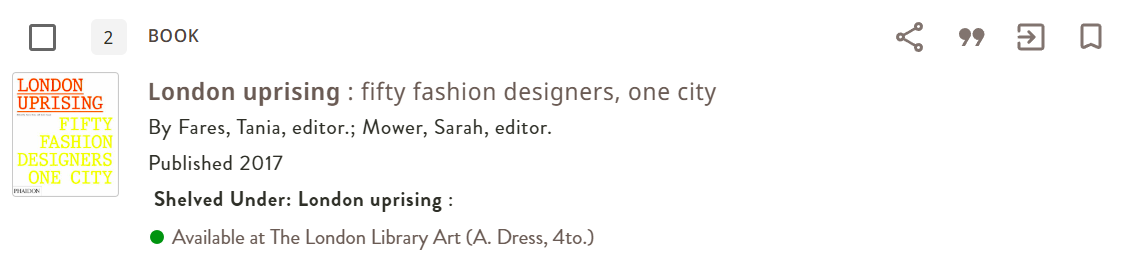
Above is an example of a book record from the Catalogue. Here you can see that the book is shelved under the title rather than the author’s name, as it is an edited work, and that it is available (i.e. on the shelf) in the Art section (A.), in the sub-section ‘Dress’ of the 4to. sequence, and then shelved under London. To avoid confusion over alternative spellings of artists' names, please note down shelfmarks exactly as they appear in the Library Catalogue.
Please note that some categories cover a very large number of books (e.g. A. Art (Gen.) and A. Painting), while others are very small, possibly containing only one or two books each.
Books may be requested and put aside for ready for collection, but we would always encourage members to browse the shelves for themselves and discover the books they did not know they needed. Items from the Library’s Special Collections that cannot be borrowed, can be consulted in the Library under supervised conditions with 72 hours’ notice.