
A guide to the biography collections
Scope of the collection
The Biography collection covers all biographical and autobiographical works covering individuals, families or collectives and includes diaries, journals, correspondence and speeches.
Founded in 1841, the Library’s collection has grown each year and we hold titles from the late 18th century onwards on the open shelves. As a result, our collection reflects the evolution and changes in thinking in a particular subject and does mean that you may come across titles which contain ideas and vocabulary that would be considered abhorrent today. The collection continues to grow with some 5,000 new titles being added each year. As we develop the collection, we seek to ensure that the controversial topics of today are represented from all sides of a debate.
Understanding shelfmarks
The collection is divided into broad subject areas (History, Literature, Topography, for example) and then into smaller subject areas, arranged alphabetically. Within each section, books are generally arranged by author name but edited titles are filed under the book title instead. Check the Catalogue record for the ‘shelved under’ information.
In Biography, books are filed alphabetically by the name of the book’s subject. If two subjects have the same surname, the first name is taken into account. Books about a family will precede books about the individual. For example, a shelf order may run Smith, family of, followed by Smith, Anna, then Smith, Emily etc. Please note that names are treated as one word regardless of gaps, hyphens or apostrophes. Names that start Mc are treated as though the spelling is Mac.
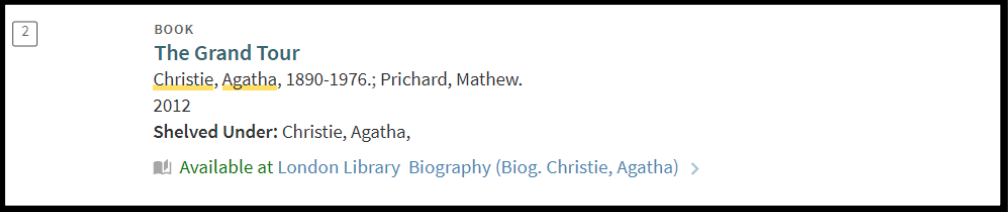
Above is an example of a book record from the Catalogue. Here you can see that the book is shelved under the author’s name and that it is available (i.e. on the shelf) in the Biography section (Biog.), and then in the Christie sub-section. Within the section of each author, titles are shelved in the following order:
- Autobiographies and Memoirs
- Correspondence and Letters
- Diaries and Journals
- Speeches
- Books written about the subject
In the second example, the book will be in the Christie sub-section, but shelved under the author’s name within that section. Please note that in order to make the most effective use of space, the collection is also shelved by size. Check the end of shelf marks for the notations 4to (quarto), folio and folio extra large that may indicate a different place to look for the books. In general, larger volumes are shelved in the same room as the smaller.
Books may be requested and put aside for ready for collection, but we would always encourage members to browse the shelves for themselves and discover the books they did not know they needed. Rare texts and anything published before 1700 may have been moved to our Special Collections. Items that cannot be borrowed, can be consulted in the Library under supervised conditions with 72 hours’ notice. Please speak to staff in the Issue Hall if you have any questions.
Books and eBooks
The Library’s collection includes both academic eBooks and other fiction and non-fiction eBooks available through the Libby platform. All academic eBooks will appear in your search results in the Library Catalogue. Those available through Libby are also in our Catalogue but can also be searched separately through the Libby platform, which you also need in order to access these titles.
Most biographical material is classified within the Biography shelfmark and located on Floors 3 and 4 of the Central Stack.
Exceptions to this are:
- Popes: biographical works on Popes, including autobiographical works, can be found in
- Monarchs and consorts: biographical works on English monarchs and consorts can be found in H. England, Kings &c., in alphabetical order by name, and within this by reign or in the general H. England sequence by name. Other monarchs and consorts can be found in the general History sequence, usually within their own subject heading, e.g. works on Napoleon I will be found in H. Napoleon I and works on Josephine will be found in H. Josephine, Empress of the French.
- Art and Literature: if a work covering an individual or group contains a significant amount of work by the subject/s then this may be classified with the subject’s work in Art or Literature, rather than Biography.
- The Three Great Exceptions: All works by or about Dante; Goethe & Shakespeare, including biographical work can be found in Literature.
- Dante - biographical work on Dante can be found in author order under L. Italian Lit., Dante.
- Goethe - biographical work on Goethe can be found in author order under L. German Lit., Goethe.
- Shakespeare - biographical work on Shakespeare can be found in author order under L. English Lit., Shakespeare.
If you are looking for material about a specific person or family, it may be useful to consider different forms of name, titles and for married women if they were known by this or their maiden name.
Journals, eJournals and online resources
While not subscribing to any specific biographical journals, biographical material will be found in many other subscribed titles. An articles search on the Catalogue will retrieve much of this material. The Library also holds the proceedings and publications from literary and historical societies (including many local historical societies) which can be a rich source of biographical studies.
The Library subscribes to a number of electronic resources covering biographical material including the Oxford Dictionary of National Biography, Who’s who/Who was who, and Crockford’s clerical directory. The full list of electronic resources may be found on the Catalogue homepage. There is also a wealth of newspaper resources that can be searched.