
Economics and finance collections
Scope of the collection
The initial selection of books on political economy for the Library in the 1840s fell to John Stuart Mill. William Baker provided a brief outline of Mill’s work as a selector in The Early History of the London Library, 1992. Today the subject ‘economics’ is covered at The London Library by a variety of shelfmarks in the monograph collection and by a number of periodicals both defunct and current. However, country-specific economic history works are shelved in the History sections, e.g. H. England, Social & Economic, H. France, Social & Economic. The collection has a strong 19th century base but some shelfmarks, notably S. Trade, have a good 18th century core. There is a good smattering of European languages, particularly in the early period. We continue to collect actively in economic and business history and in most of the special subject sections when relevant books appear.
Understanding shelfmarks
The Library’s collection is divided into broad subject areas (e.g. History, Literature, and Topography) and then into smaller areas, arranged alphabetically. Within each subject category, books are arranged alphabetically by their author’s surname or, in the case of edited collections or books with multiple authors, by their title. Check the Catalogue record for the ‘shelved under’ information.
In order to make the most effective use of space, the collection is also shelved by size. Check the end of shelfmarks for the notations 4to. (quarto), small folio, folio, and folio extra large, which may indicate a different place to look for the books.
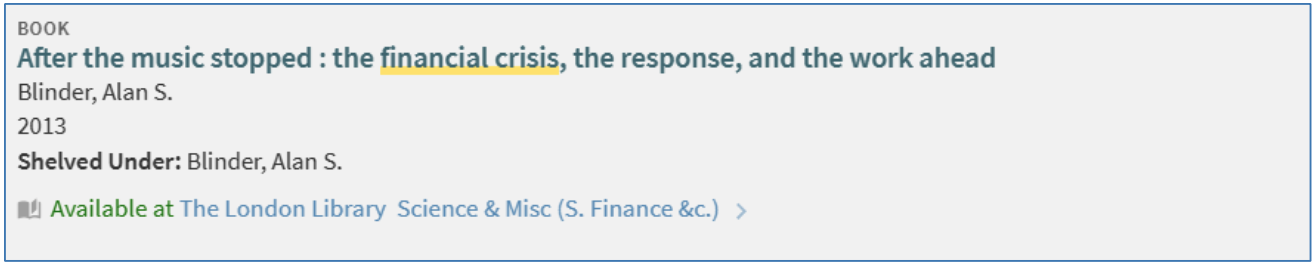
Above is an example of a book record from the Catalogue. Here you can see that the book is shelved under the author’s name and that it is available (i.e. on the shelf) at in the Science & Miscellaneous section (S.), in the sub-section for Finance &c., and then shelved under the author Blinder.
Labels on the edges of the shelves will guide you through the section. Some shelfmarks are large, such as S. Political Economy, and are subdivided further by letters marking the authors’ surnames (or titles in the case of edited collections).
Books may be requested and put aside ready for collection, but we would always encourage members to browse the shelves and discover books serendipitously. Items from the Library’s Special Collections cannot be borrowed but may be consulted in the Library under supervised conditions, given 72 hours’ notice.
Scope of the collection
The initial selection of books on political economy for the Library in the 1840s fell to John Stuart Mill. William Baker provided a brief outline of Mill’s work as a selector in The Early History of the London Library, 1992. Today the subject ‘economics’ is covered at The London Library by a variety of shelfmarks in the monograph collection and by a number of periodicals both defunct and current. However, country-specific economic history works are shelved in the History sections, e.g. H. England, Social & Economic, H. France, Social & Economic. The collection has a strong 19th century base but some shelfmarks, notably S. Trade, have a good 18th century core. There is a good smattering of European languages, particularly in the early period. We continue to collect actively in economic and business history and in most of the special subject sections when relevant books appear.
Founded in 1841, the Library’s collection has grown each year and we hold titles from the late 18th century onwards on the open shelves. As a result, our collection reflects the evolution and changes in thinking in a particular subject and does mean that you may come across titles which contain ideas and vocabulary that would be considered abhorrent today. The collection continues to grow with some 5,000 new titles being added each year. As we develop the collection, we seek to ensure that the controversial topics of today are represented from all sides of a debate.
Books and eBooks
The Library’s collection includes both academic eBooks and other fiction and non-fiction eBooks available through the Libby platform. All academic eBooks will appear in your search results in the Library Catalogue. Those available through Libby are also in our Catalogue but can also be searched separately through the Libby platform, which you also need in order to access these titles.
The content of a selection of the most relevant shelfmarks is outlined below.
S. Political Economy
This is the largest section directly relevant to the study of economics covering capitalism, economic theory, 19th century introductions to economics, economic growth, general economic histories of Europe, neoliberalism, criticism of writers on economics. The earliest work on the open shelves is 1803-16 Scrittori classici italiani di economia politica (50v). Other works here include Marx’s Kapital ; Adam Smith’s Inquiry into the wealth of nations and Malthus’ Essays on political economy in 8 volumes.
S. Capital & Labour
Subjects covered include: producers and consumers, some individual skills, apartheid in South African mines, histories of labour, imperial aspects, peasantry, international labour movements, migrant labour, working class histories, official reports (e.g. Industrial Fatigue Research Board 1919-1937), labour relations, and the General Strike. The period 1840-1870 is particularly strong, as is 1890s onwards. Works include 1844 The claims of labour – duties of the employer to employees; 1861 Workman’s earnings; 1861 Mayhew’s London labour London poor; 1868 The great unwashed; 1871 Workman’s rights; 1889 Booth’s London life & labour.
S. Corporations
Works covering the history of companies, and early professional guides to running companies.
S. Finance &c.
The full shelfmark is S. Finance & Banking. Subjects include investment, wealth distribution, credit/debt, foreign exchange and currency, financial markets, bank histories, interest rate tables, South Sea Bubble. Many of the early titles have a more practical bent but they gradually move into more serious study of the subjects. Early titles include 1705 John Broughton’s Remarks upon the Bank of England with regard to trade and government; 1802 William Fairman’s The stocks examined and compared, or, a guide to purchases in the public funds; and 1828 William Cobbett’s Paper against gold.
S. Friendly Societies
Includes works on Building societies, savings clubs etc.
S. Industries
Works on industries from cottage to international, rural craft workers, government papers on industrial policy, histories of industries by county.
S. Insurance
Covers life insurance, Lloyds, county fire office, pensions, government papers including the Beveridge report.
S. Petroleum
Covers the industry and politics/economics of oil.
S. Political Science
Although these titles concentrate on politics rather than economics, some general works on communism and totalitarianism can be found here. More, including works on Marxism, are shelved at S. Social Science. As with Political Economy, works relating to a specific country are shelved in the history of the country.
S. Prices
Theory of pricing, wage control, Beveridge on prices and wages. Nothing was apparently considered too esoteric at one time, e.g. F. Waugh, Quality as a determinant of vegetable prices: a statistical study of quality factors affecting vegetable prices in the Boston wholesale market, New York, 1929.
S. Protection
Subjects covered include: free trade, and the Corn laws.
S. Taxation
Histories of taxation, principles, customs & excise, death duties.
S. Trade
Subjects covered include: commerce (both local & international), trade & tariffs, merchants, some company histories, trade routes, trade cycles, theory & policy, some specific trade subjects e.g. grain.
R.R. Dicts, Political Economy
Located in the Reading Room, these reference works include dictionaries of sociology, encyclopaedias of political institutions and social science, social thought, political organizations, industrial relations, British politics, House of Commons procedures. Terminology also is quite well covered in the Oxford companion to the politics of the world, which is a useful background to the political thought shoring up economic theory.
Bibliography, Political & Social Sciences (8vo & 4to)
The Library’s holdings include Higgs’ Bibliography of Economics 1751-1775 and the 6 volume Catalogue of Goldsmith’s Library of Economic Literature (1970-1995) which covers the period up to 1850. It is noticeable that most of the bibliographies stop around 1850. Possible reasons for this could be early collectors’ interests, the recognition of a ‘classic’ period of writing up to this time, and the revolutions in Europe in 1848. This early period covered a great many pamphlets on relevant subjects and the bibliographies have tried to pull them together from highly diverse sources.
Special collections
The Library’s Pamphlet Collection was undoubtedly strong in early works on economics and still contains items of interest. Monograph material in the Anstruther Wing includes works by Ricardo, Ruskin, JS Mill, Jevons, Senior, and Pigou plus a donation from the Political Economy Club in 1857 of a volume of scarce 17th & 18th century tracts.
We also have 50 or more publications from the Cobden Club whose interests covered ‘economics’ as we are dealing with it here. They date from 1870 through to 1944 and are best retrieved through a Catalogue search under Cobden Club as they are well scattered throughout various shelfmarks.
Journals, eJournals and online resources
The Library maintains a subscription to The economist and a complete backrun of issues can be found in the Basement. The eLibrary allows access to JSTOR and resources such as British history online where a plethora of primary sources can be accessed.