
Art collections
Scope of the collection
The Library's books on fine and applied art are housed in the Art Room, up the short flight of steps leading from the main Issue Hall. Periodicals on art and related subjects are kept in the Library's general sequence, with current issues available from the Reading Room and earlier bound volumes shelved in the Periodicals section in the basement.
Founded in 1841, the Library’s collection has grown each year and we hold titles from the late 18th century onwards on the open shelves. As a result, our collection reflects the evolution and changes in thinking in a particular subject and does mean that you may come across titles which contain ideas and vocabulary that would be considered abhorrent today. The collection continues to grow with some 5,000 new titles being added each year. As we develop the collection, we seek to ensure that the controversial topics of today are represented from all sides of a debate.
The Art Room comprises books on two levels, with a third level in TS Eliot House, and a reading room in the middle. The sequence starts on the ground floor with quarto-sized books (4to) and continues on the gallery above, where the quarto sequence ends. Art then continues with the octavo-sized books in T S Eliot House, on the mezzanine floor (Floor M). Small folio sized books are in the adjacent Central Stack, mezzanine floor, at the end of the octavo sequence.
The Library continues to acquire books and exhibition catalogues on major artists and architects, art history, criticism and theory. The main strength is in European art from 1500 to the 1960s. Catalogues raisonnés of major artists acquired whenever possible. Art of the Americas, Asia and Africa are also represented. The emphasis is on English language publications, with some works in other major European languages also included. Film, photography, fashion and crafts are all located in the Art collection.
Understanding shelfmarks
The collection is divided into broad subject areas (History, Literature, Topography, for example) and then into smaller areas, arranged alphabetically. Within each section, books are generally arranged by author name but edited titles are filed under the book title instead. Check the Catalogue record for the ‘shelved under’ information.
In order to make the most effective use of space, the collection is also shelved by size. Check the end of shelf marks for the notations 4to (quarto), small folio, folio and folio extra large that may indicate a different place to look for the books.
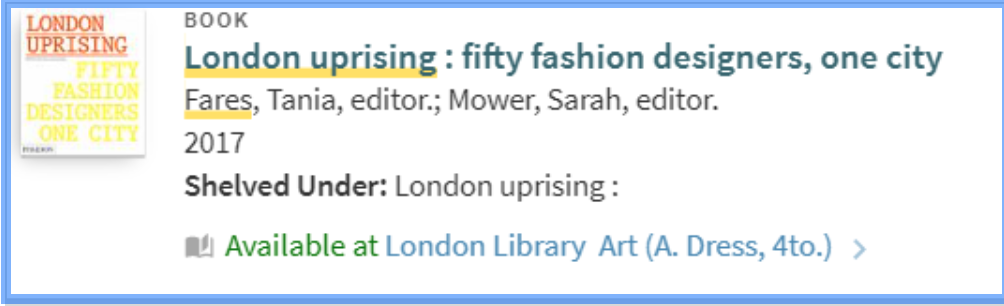
Above is an example of a book record from the Catalogue. Here you can see that the book is shelved under the title rather than the author’s name, as it is an edited work, and that it is available (i.e. on the shelf) in the Art section (A.), in the sub-section ‘Dress’ of the 4to sequence, and then shelved under London. To avoid confusion over alternative spellings of artists' names, please note down shelfmarks exactly as they appear in the Library Catalogue.
Please note that some categories cover a very large number of books (e.g. A. Art (Gen.) and A. Painting), while others are very small, possibly containing only one or two books each.
Books may be requested and put aside for ready for collection, but we would always encourage members to browse the shelves for themselves and discover the books they did not know they needed. Items from the Library’s Special Collections that cannot be borrowed, can be consulted in the Library under supervised conditions with 72 hours’ notice.
Books and eBooks
The Library’s collection includes both academic eBooks and other fiction and non-fiction eBooks available through the Libby platform. All academic eBooks will appear in your search results in the Library Catalogue. Those available through Libby are also in our Catalogue but can also be searched separately through the Libby platform, which you also need in order to access these titles.
Books are shelved in separate sequences according to size: octavo, quarto (4to.), small folio or folio. The larger size indicators appear at the end of the shelf-mark in the Library's catalogue entries, for example, Architecture, 4to., Cinema, &c, sm. Folio, or Engraving, folio. If there is no size indicator, the volume is octavo-sized.
Within each size sequence, the subject categories are arranged alphabetically. A detailed floor plan for the Art Room is available from the Issue Desk.
The ground floor Art Room houses 4to. material, and begins on the far left of the room on the shelves immediately next to the lift. The 4to. sequence runs clockwise around the outer wall to the glass door and then continues in a clockwise direction on the left side of the inner arc of shelves in the centre of the room. The sequence then continues on the outer shelves of the inner arc running anti-clockwise back to the free-standing shelves directly facing the lift. The remainder of the 4to. sequence is shelved on the balustrade on the gallery running anti- clockwise from the top of the stairs.
The octavo sequence is housed on the Mezzanine, easily reached by the T S Eliot House stairs or lift from the 1st floor. It continues on the Mezzanine of the Central Stack, up four steps from T S Eliot House. The small folio sequence is located next to the end of octavo, in the Central Stack.
Art folio titles are stored separately and should be requested at the Issue Desk.
If the Library holds a significant number of books about a single artist, including critical works, the name of the artist appears as part of the shelf-mark in the catalogue entry:-
- A. Painting, Picasso
- A. Artistic Anatomy, Stubbs
Catalogues of works from a single gallery are shelved alphabetically under the name of the gallery, within the appropriate subject category. For example, A. Painting, A. Sculpture, etc for exhibitions covering works in a single medium, or A. Art (Gen.) for exhibitions including works in more than one medium.
Loan exhibition catalogues (i.e. with works from a number of collections) are shelved alphabetically by title of the exhibition. Catalogues from exhibitions of a single artist, however, are treated as standard monographs and shelved under the name of the artist, within the relevant subject category (e.g. A. Painting), and then alphabetically by author or by gallery.
Always check the Library Catalogue carefully for the ‘shelved under’ information which will help you locate the book within the shelfmark sequence.
Journals, eJournals and online resources
The Library holds several periodical titles that complement the religion collection. Some of these titles are either no longer subscribed or are defunct but the Library retains back issues in its collection. Titles include:
Apollo, 1925-
Ars Orientalis*, 1954-
Art Bulletin, 1918-
Art History, 1978-
Art Journal, 1960-
Art Monthly, 1976-
Art Newspaper, 1983-
Art Review, 1949-
Artibus et Historiae*, 1980-
British Art Journal, 1999
British Journal of Aesthetics, 1961-
Burlington Magazine, 1903-
Ceramic Review, 1970-
Church Monuments, 1985-
Crafts, 1973-
Dumbarton Oaks Papers*, 1941-
Furniture History, 1965-
Georgian Group Journal, 1991-
Irish Arts Review Yearbook*, 1984-
Journal of Glass Studies, 1959-
Master Drawings, 1963-
Modern Painters, 1988-
Oxford Art Journal, 1978-
Print Quarterly, 1984-
RA: the Royal Academy Magazine, current year
Regional Furniture, 1987-
The Sculpture Journal, 1997-
Silver Society Journal, 1990-
Textile History, 1968-
Current issues of titles marked * are not displayed in the Reading Room racks: please enquire at the Issue Desk. Earlier issues of most titles are available for loan in bound volumes, from the main Periodicals and Societies sections in the Basement or in our off-site storage; please check the Catalogue for precise shelfmarks.
The Library subscribes to a number of online resources useful for readers and researchers in art, as well as newspaper archives and other generic services that cover art:
Art History Research Net,
Country Life Archive,
International Bibliography of Art,
Oxford Art Online
All are available within the Library and remotely. Access is via the Library Catalogue, using your login credentials.